

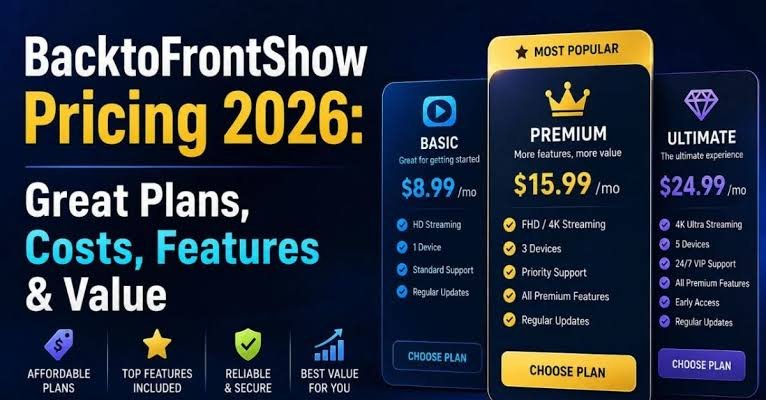

BackToFrontShow Pricing: Why the Search Results Contradict Each Other
Okay, so you typed “backtofrontshow pricing” into Google. Fair enough, normal thing to do before spending money on anything. Except, if you actually read past the first result or two, something weird happens. The answers start disagreeing with each other. Wildly.
I went looking too. And honestly? What I found is a genuinely useful lesson in how messy online research has gotten, maybe more useful than a straight pricing breakdown would’ve been anyway.
What I Actually Found
Here’s the thing. I checked a handful of articles all claiming to explain “backtofrontshow pricing.” And they don’t agree on the basics. Not the price. Not even what the product is.
One article describes it as a podcast analytics platform, monthly plans running well into the thousands of dollars, aimed at media teams. Another describes it as an online creator training platform, monthly cost closer to thirty or sixty dollars, aimed at solo entrepreneurs. A third frames it as some kind of virtual entertainment or event-booking service entirely. A fourth just talks vaguely about “business intelligence solutions” without pinning down anything concrete at all.
That’s not normal variation, the kind you’d expect from, say, five reviewers describing the same product slightly differently. That’s four completely different products, wearing the same name, none of them agreeing on the fundamentals.
Why This Happens
I think it’s worth explaining this properly, because it’s honestly becoming a bigger problem across the internet generally, not just with this one search term.
A lot of content online now gets produced specifically to rank for a search phrase, rather than to genuinely answer the question behind it. When a term like “backtofrontshow pricing” starts getting searched, even in small volume, it can attract a wave of quickly-produced articles built purely to capture that traffic. Ad revenue, affiliate links, that sort of thing.
The problem is, if nobody writing those articles actually knows what the underlying product is, or if the product itself is obscure, poorly documented, or barely exists in a coherent public form, you end up with exactly what I found here. A pile of confident-sounding articles, all contradicting each other, all somehow presenting themselves as the definitive answer.
It’s a bit like asking five people what a stranger looks like, and getting five completely different descriptions. At some point, you have to wonder whether anyone actually saw the person at all.
The Real Lesson Here
Look, I think this is actually a more useful thing to walk away with than a fake, confidently-stated price would’ve been. Because this pattern shows up constantly, and knowing how to spot it protects you from wasting time, or worse, money, chasing bad information.
A few honest signals that you might be looking at this exact situation, rather than a genuinely inconsistent but real product:
- The core description contradicts itself across sources, not just the price, but what the thing actually is.
- Every article was published very recently, often within the same few-month window, which suggests a content wave rather than organic, ongoing coverage.
- Specific numbers appear with suspicious confidence but don’t match between sources, exact dollar figures, oddly precise feature lists, that sort of thing.
- The official website is hard to pin down, or different articles link to entirely different domains claiming to be “the” official site.
- The writing feels templated, similar sentence structures, similar phrasing, repeated across supposedly independent sources.
If you’re hitting more than two or three of these at once, honestly, that’s your answer. Treat everything you’re reading with real scepticism.
What to Actually Do Instead
So, what’s the actual move here, if you genuinely want pricing for a service like this?
Go straight to the primary source. Skip the third-party “guides” entirely and find the company’s own official website. Pricing pages, when they exist, are usually the most reliable single source, provided you can actually confirm you’ve landed on the real domain and not an imposter.
Check for a live chat or contact form. If pricing isn’t published clearly, most legitimate services will let you ask directly. A vague or evasive answer there is itself useful information.
Search for the company on a business registry, if it claims to be a formal company, that at least confirms it exists as a legal entity, even if it doesn’t confirm pricing specifically.
Look for reviews on independent, harder-to-fake platforms. Trustpilot, G2, Capterra, these tend to be more resistant to the kind of mass-produced content that shows up in general search results, though even these aren’t immune to manipulation entirely.
Be suspicious of round, oddly specific numbers repeated across “different” sources. If three unrelated articles all quote the exact same price down to the dollar, that’s not confirmation, that’s often just one article copying another, or all of them copying a template.
Why I Didn’t Just Make Up an Answer
I could’ve picked one of those conflicting numbers and presented it as fact. Would’ve made for a tidier article, honestly, the kind that reads clean and confident. But it also would’ve meant handing you a number I genuinely can’t verify, and that’s a worse outcome than just being upfront about the mess.
I think that’s actually the more useful service here. Not a fake answer dressed up as a real one, but an honest explanation of why the real answer isn’t findable right now, and what to actually do about that.
Final Thoughts
If you’re trying to find real pricing for “BackToFrontShow” specifically, your best bet is going directly to whatever you can confirm is the official site, and treating every third-party “pricing guide” you encounter with a healthy dose of scepticism until it lines up with something you can independently verify.
More broadly, though, this whole situation is a decent reminder that a confident tone online doesn’t automatically mean accurate information. Cross-check the basics, the actual product description, before you even get to the price. If the basics don’t line up, the price definitely won’t either.