

What Does “Hayati” Mean? The Full Definition, Origin, and How It’s Actually Used
Ever heard someone call their partner “hayati” and just… nodded along, pretending you knew what it meant? No judgment. I did exactly that the first time I heard it in a song lyric. Took me an embarrassingly long time to actually look it up.
So let’s actually sort this out properly.
The Short Answer
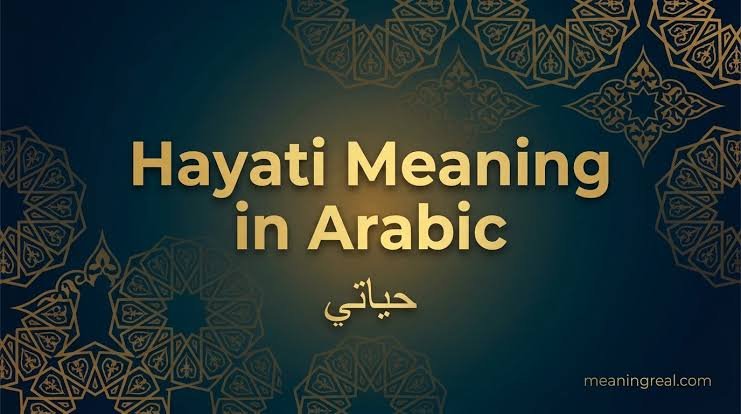
Hayati (حياتي) is an Arabic word that literally means “my life.” It’s pronounced roughly ha-ya-tee, with the emphasis landing gently on that middle syllable.
But here’s the bit that trips people up: nobody’s actually calling someone “my life” in the literal sense, like they’re describing a biography. It’s used as a term of endearment, similar to how English speakers might say “babe” or “love” or, honestly, the way some people say “you’re my whole world” to someone they adore.
Simple enough on paper. The nuance comes from how deep that phrase actually runs.
Breaking Down Where the Word Comes From
Hayati comes from the Arabic root ḥ-y-y, which relates to life, living, being alive — that whole cluster of meaning. The base word is hayat, meaning “life.” Add the possessive ending “-i,” and you get “hayati,” which literally translates to “my life.”
That possessive construction matters, I think. It’s not just “life” as an abstract concept. It’s your life, specifically claimed, specifically pointed at someone. There’s something quietly intense about that grammatically, even before you factor in tone or context.
The word’s been borrowed into other languages too, which says something about how far its emotional weight travels. It shows up in Ottoman Turkish, and from there made its way into modern Turkish and various Balkan languages. It’s also genuinely popular as a given name in places like Malaysia, Turkey, and across parts of North Africa.
Why “My Life” as a Term of Endearment?
I think this confuses non-Arabic speakers more than any other part. In English, calling someone “my life” would sound almost theatrical, over the top, like something out of a soap opera. But in Arabic, it sits comfortably alongside other everyday terms of affection.
Compare it to “habibi” or “habibti,” which mean “my love” or “my darling.” Hayati sits in that same casual-affection family. You’ll hear it between romantic partners, sure, but also between close friends, family members, even used lightly and warmly toward children.
It’s roughly equivalent to “jaan” in Urdu and Hindi, or “joon” in Farsi — all of these, interestingly, also trace back to that same idea of “life” or “soul” as an expression of deep fondness. Different languages, same instinct, apparently: when words like “cute” or “sweet” aren’t enough, reach for something bigger. Reach for life itself.
How Is It Actually Used in Real Conversation?
Honestly, it’s pretty flexible. A few common ways you’ll hear it used:
As a direct term of address: “Hayati, where are you?” — basically “Babe, where are you?”
As a sign-off in messages or calls: “Bye, hayati” or “Love you, hayati.”
In song lyrics, which, if you’ve ever listened to Arabic pop or Lebanese music, comes up constantly. It’s practically a genre staple at this point.
Between close friends, sometimes platonically, particularly in casual, warm conversation.
I’ve noticed it pop up a lot in music, too — Massari’s got that well-known line, “inta hayati, inta habibi,” which basically translates to “you’re my life, you’re my love.” Classic pairing, those two words together. If you’ve heard Arabic-influenced pop music at any point, there’s a decent chance you’ve heard “hayati” without clocking it.
Is It Only Romantic?
Not necessarily, no. This is where I think a lot of quick definitions oversimplify things.
While hayati is definitely used romantically, and probably most commonly that way, it’s not exclusively a romantic word. Parents say it to children. Close friends say it to each other. It’s warm, it’s affectionate, but it’s not locked to one specific relationship type the way, say, “husband” or “girlfriend” would be.
Context does most of the heavy lifting here, honestly. The same word, said by a mother to her toddler versus said between partners, carries a slightly different emotional flavour, even though the literal meaning stays identical.
Hayati as a Given Name
Beyond the everyday term of endearment, hayati also functions as an actual first name, given to both boys and girls depending on the region. As a name, it often gets translated as “vital” or “full of life,” which tracks nicely with the root meaning.
It’s a name with genuine reach, too. You’ll find it used across Turkey, Malaysia, Morocco, Algeria, and Saudi Arabia, among other places. A handful of fairly well-known people have carried it as well — Turkish actors, poets, and public figures, mostly, spanning Ottoman-era literature right through to more recent political figures.
A Word Worth Knowing
I think what makes “hayati” genuinely interesting, beyond just being a nice word to drop into conversation, is what it reveals about how language handles affection. English tends to reach for smaller, lighter words for endearment — “babe,” “hun,” that sort of thing. Arabic, at least here, goes big. Goes existential, almost. “You are my life” isn’t a metaphor being used lightly. It’s meant.
So next time you hear someone say “hayati” in a song, or see it as a caption under a couple’s photo, you’ll know exactly what’s being said, and honestly, why it hits a bit differently than just saying “babe.”
It’s not a small word. It’s carrying a lot, wrapped up in six letters.










Leave a Reply