

Dilip Pungliya’s Blueprint for Smart Cities, Explained Simply
Estimated read time: 6 minutes
Cities are getting smarter, apparently. You’ve heard that phrase a hundred times by now, probably. Smart bins, smart traffic lights, smart everything. But here’s the thing nobody really explains properly: smart for who, exactly?
That question is basically the whole heart of the Dilip Pungliya Blueprint for Smart Cities research, and it’s worth actually unpacking properly, rather than just nodding along at the buzzword.
Table of Contents
- Who Is Dilip Pungliya?
- What Is “Blueprint for Smart Cities,” Exactly?
- The Core Idea: A Social Contract for Cities
- The Quadruple Helix Framework
- Why This Framing Actually Matters
- Human-Centric Design: The Recurring Theme
- The Bigger Picture: Ztudium and Citiesabc
- Why Should Students or Everyday Readers Care?
- FAQ
- Final Thoughts
Who Is Dilip Pungliya?
Before diving into the blueprint itself, it helps to know who’s actually behind it. Dilip Pungliya is a technology thought leader, author, and investor. He’s the Co-Founder, VP, and Chief Business Officer at ztudium, a company working across Web 3.0, artificial intelligence, blockchain, and the metaverse. Big scope, honestly.
He’s also held serious data architecture roles at major organisations, Shell, Deutsche Bank, HSBC Investments, ICBC Standard Bank, and a UK government environmental department, among others. That’s a résumé rooted in actual data infrastructure work, not just theory or slide decks.
He holds a degree in Electrical and Electronics Engineering and is a certified professional data architect. Beyond the corporate side, he’s known for philanthropic work too, particularly active during the COVID-19 pandemic. So this isn’t someone parachuting into “smart cities” as a passing trend. It’s someone who’s spent years working with the underlying systems that actually make cities function.
What Is “Blueprint for Smart Cities,” Exactly?
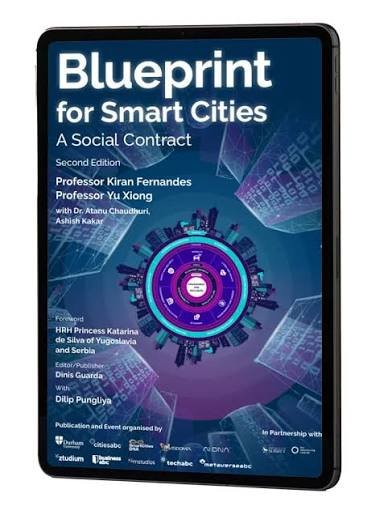
Here’s where it gets genuinely interesting. “Blueprint for Smart Cities: A Social Contract” isn’t a casual opinion piece or marketing report dressed up to look serious. It’s a proper research publication, developed over roughly 18 months, produced through collaboration between citiesabc.com and researchers at the University of Durham, led by Professor Kiran Fernandes.
Pungliya, alongside citiesabc founder Dinis Guarda and a wider board, helped shape and produce the report through the citiesabc platform. It’s genuinely academic in grounding, not just tech-industry buzzwords stitched together, which, honestly, is refreshing in a space absolutely stuffed with vague “smart city” marketing.
The Core Idea: A Social Contract for Cities
Right, so here’s the bit that actually matters most, I think. The report’s central argument isn’t really about gadgets or sensors at all. It’s about people.
The idea of a “social contract” for smart cities means this: technology alone doesn’t make a city smart. What makes it genuinely smart is how well it serves the actual humans living in it. Sounds obvious when you say it out loud, doesn’t it? But a shocking number of smart city projects seem to forget that part entirely, chasing flashy tech instead of asking whether anyone actually benefits from it.
The Quadruple Helix Framework
The report leans on what’s called a “quadruple helix” framework, four key stakeholder groups that need to work together for a smart city to actually function well: universities, businesses, governments, and the environment.
Miss one of those, and the whole system tends to wobble. I think that’s a genuinely useful way to frame it, honestly, because most failed smart city projects I’ve read about tend to lean too heavily on just one of those groups, usually government or business, while quietly ignoring the rest.
Universities bring research and evidence. Businesses bring implementation and funding. Governments bring policy and regulation. The environment, arguably the most overlooked pillar, brings the actual constraints everything else needs to respect. Four legs on the stool. Remove one, and it tips over eventually.
Why This Framing Actually Matters
I’ll be honest, when I first started reading about smart cities years back, most of what I found was just tech-company marketing dressed up as vision statements. Sensors here, AI there, some vague promise about “efficiency.” Nice words, thin substance.
What’s different about this blueprint is the explicit tie to United Nations Sustainable Development Goals, specifically SDG 8 (decent work and economic growth) and SDG 11 (making cities inclusive, safe, resilient, and sustainable). That’s not a small detail. It roots the whole conversation in something measurable and globally recognised, rather than marketing language a single tech company invented internally for a pitch deck.
Professor Fernandes’ own framing captures it well: a smart city isn’t just “smart plus city.” It’s about who’s actually leading the city, and whether development happens for people, not just at them.
Human-Centric Design: The Recurring Theme
If there’s one phrase that keeps surfacing across this whole body of work, it’s “human-centric ecosystem.” Not a coincidence, I think. It’s clearly deliberate, a corrective to years of smart city hype that got obsessed with technology for its own sake.
Practically, that means asking different questions before rolling out new tech in a city. Not just “can we install this?” but “does this actually improve daily life for residents?” Not just “is this efficient?” but “who gets left out if we build it this way?”
Those questions sound simple. In my experience, they’re the ones that get skipped most often, because they’re harder to answer and slower to implement than just buying new hardware and calling it innovation.
The Bigger Picture: Ztudium and Citiesabc
Worth knowing, too, that this research doesn’t exist in isolation. It sits within a bigger platform, citiesabc.com, which tracks and ranks smart cities globally, alongside a wider vision involving Web 3.0 technologies, data marketplaces, and even metaverse-driven city experiences.
That’s ambitious, genuinely. Whether all of it plays out exactly as described remains to be seen, emerging tech promises don’t always land the way they’re pitched. But the underlying research behind the blueprint itself, the actual social contract framework, feels grounded in something more substantial than speculative tech hype alone.
Why Should Students or Everyday Readers Care?
Good question, honestly, because “smart cities” can feel like a distant, abstract topic if you’re not directly working in urban planning or tech policy.
But here’s the thing. If you live in a city, and most people reading this probably do, these ideas eventually touch your daily life. Traffic systems, public services, environmental policy, digital infrastructure, all of it increasingly gets shaped by frameworks like this one, whether residents are aware of it happening or not.
Understanding the human-centric angle, rather than just the tech-hype version, gives you a much better lens for evaluating whether a city project near you is actually serving residents, or just chasing a shiny headline for a press release.
FAQ
What is the Blueprint for Smart Cities report? It’s a research publication titled “Blueprint for Smart Cities: A Social Contract,” produced through an 18-month collaboration between citiesabc.com and the University of Durham, led by Professor Kiran Fernandes.
What is Dilip Pungliya’s role in the report? He’s a Partner and Board member at citiesabc, and Co-Founder, VP, and Chief Business Officer at ztudium, contributing to the research and platform behind the blueprint.
What does “social contract” mean in this context? It refers to the idea that smart cities need an agreed framework between key stakeholders, universities, businesses, governments, and the environment, to ensure development actually benefits residents rather than just showcasing new technology.
How does this relate to the UN Sustainable Development Goals? The report directly ties its recommendations to SDG 8 (economic growth and decent work) and SDG 11 (inclusive, safe, resilient, sustainable cities), grounding it in globally recognised benchmarks.
Is this report purely theoretical, or does it apply practically? It’s positioned as a practical framework meant to guide real urban development decisions, developed collaboratively with input from businesses, governments, and academic researchers rather than as a purely abstract exercise.
Final Thoughts
Dilip Pungliya’s involvement in the Blueprint for Smart Cities research points toward something the whole industry genuinely needed more of: a grounded, academically-backed reminder that smart cities are, at the end of the day, still about people first.
Technology’s the tool. People are the point. Simple framing, honestly, but it’s one that gets lost more often than it should in an industry that loves shiny gadgets a little too much.











Leave a Reply