


What Is “Levapioli,” Really? The Truth Behind the Viral Food Word
Okay, so you Googled “levapioli.” First result says it’s a Balkan grilled meat dish. Second one says it’s a stuffed dough thing. Third one calls it a superfood with antioxidant benefits. Fourth one describes it as an actual city you can visit in Europe.
Something’s off there, right? Four sources, four completely different answers. That’s not normal for a real, established word. And honestly, once you notice that pattern, it tells you almost everything you need to know.
Let’s actually get into what’s going on.
There’s No Single Agreed Definition. That’s the First Clue.
Here’s the thing nobody’s saying plainly enough: “levapioli” doesn’t have one accepted meaning anywhere. Not in a dictionary. Not in any culinary reference. Not in any historical record of Balkan or Mediterranean cuisine.
Genuine food terms, even obscure regional ones, tend to be consistent across sources. Ask five people what a croissant is, and you’ll get roughly the same answer five times. Ask five websites what “levapioli” is, and you’ll get five wildly different stories, a meat dish, a stuffed bread, a fictional Balkan city, a wellness ingredient. That inconsistency is the tell.
So Where Did This Word Actually Come From?
I think the honest answer is: nobody actually knows, and that’s genuinely part of the story. There’s no traceable historical origin, no regional dialect record, no established recipe passed through generations, nothing that would normally exist behind a real culinary term.
What seems far more likely, based on how the word behaves online, is that it started as a made-up or AI-generated keyword. Somebody, or something, wrote an article using the term. Other content sites, chasing the same search traffic, picked it up and wrote their own versions. Each one added new invented details, a fake origin story, invented health claims, an imaginary city, without any of them actually checking whether the previous version was accurate.
That’s basically how misinformation snowballs online now. One article invents a “fact.” The next one repeats it, adds a bit more. Within a few months, there’s a whole ecosystem of pages confidently describing something that was never actually real to begin with.
What People Are Probably Actually Thinking Of
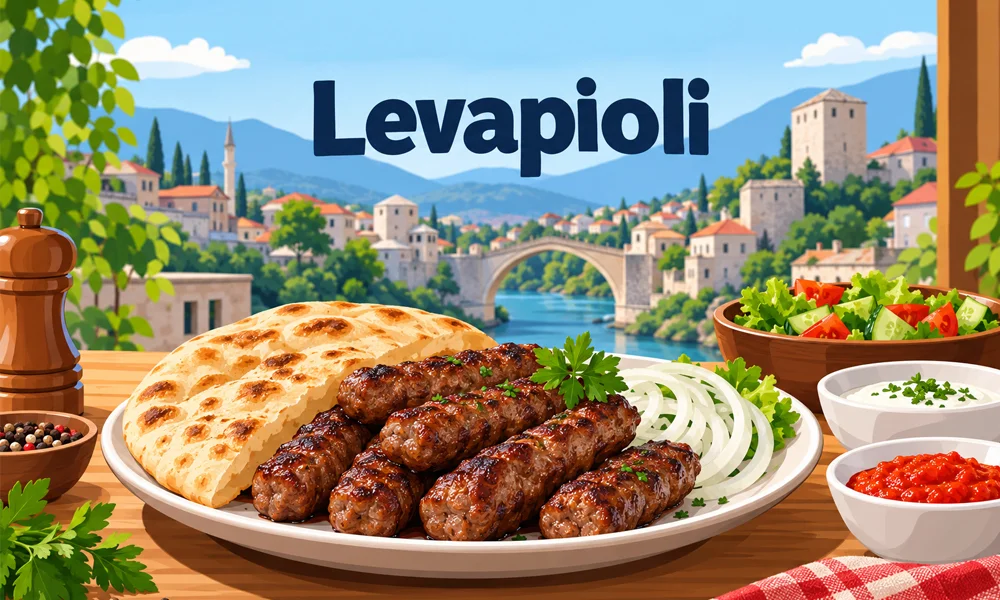
If you strip away all the noise, the recurring detail across almost every version of “levapioli” is grilled minced meat, beef or lamb, shaped into small rolls or patties, grilled over an open flame.
That description matches something real: ćevapi (also spelled cevapi or ćevapčići), a genuine, well-documented grilled meat dish from the Balkans, particularly Bosnia and Herzegovina, Serbia, and Croatia. Ćevapi has an actual, traceable history, Ottoman-influenced, regionally specific, served with flatbread, onions, and a soft cheese called kajmak.
My honest guess, and I think it’s a reasonable one, is that “levapioli” started as either a genuine misspelling, an AI mistranslation, or a deliberately invented variant name, and then got treated as a real, separate word once enough content sites repeated it.
Why Does This Keep Happening?
This isn’t actually a one-off situation, and I think that’s worth knowing too. Made-up or garbled terms going semi-viral through search-driven content farms happens more often than most people realise.
It usually follows a pattern: a word appears somewhere, sometimes through a typo, sometimes through an AI tool generating filler content, sometimes just invented outright to target an unclaimed search term. Then a wave of content sites, all chasing the same traffic, publish their own “explainer” articles. None of them cross-check the others. Each one adds a bit more invented detail to seem more comprehensive, and normal readers, who reasonably assume repeated information must be true, take it at face value.
The more sites that publish it, the more legitimate it starts to look, purely through repetition. That’s genuinely one of the trickier problems with search engines right now, volume can look a lot like accuracy, even when it isn’t.
How to Spot This Kind of Thing Yourself
A few practical signs, worth keeping in mind next time you hit a suspiciously unfamiliar term online:
- Sources contradict each other on basic facts. If one site calls something a dish and another calls it a city, that’s a major red flag, not a minor inconsistency.
- No dictionary or encyclopedia entry exists. Genuine terms, even niche regional ones, usually show up somewhere more authoritative than a cluster of blog posts.
- The content reads suspiciously similar across “different” sites. Same structure, same vague phrasing, same generic claims, just reworded. That’s a sign of content being copied and rewritten, not independently researched.
- Claims feel oddly specific but unverifiable. Precise-sounding health benefits or historical details with no actual citation are a classic filler-content pattern.
What This Means for You
Honestly, if you landed here because you’re planning to cook something, wanted to learn about Balkan cuisine, or were just curious what all the fuss was about, the real answer is: you’re probably looking for ćevapi. That’s the actual, historically grounded dish that “levapioli” content keeps orbiting around without ever quite naming correctly.
If you’re here because you noticed the weirdness and wanted to understand what’s actually going on, well, now you know. It’s a manufactured search term, not a hidden culinary gem.
Final Thoughts
“Levapioli” isn’t a secret Balkan delicacy waiting to be discovered. It’s a case study in how internet content can snowball, one invented or garbled term, repeated and embellished across enough websites, starts looking real purely through volume and repetition.
If you want the genuine version of the dish everyone’s circling around, look up ćevapi instead. It’s got the real history, the real regional roots, and, frankly, actual recipes you can trust weren’t invented by whichever site published first.
Sources referenced:
- The Bangor Magazine: “Levapioli: Origins, Meaning, Uses, and the Facts You Should Know” — one of the few sources to openly acknowledge the term has no single agreed meaning
- Wikipedia: Ćevapi — the real, documented Balkan grilled meat dish this term likely traces back to
- ReaderChief: “Levapioli Explained” — an example of a source that openly frames the term as an SEO opportunity rather than an established dish