

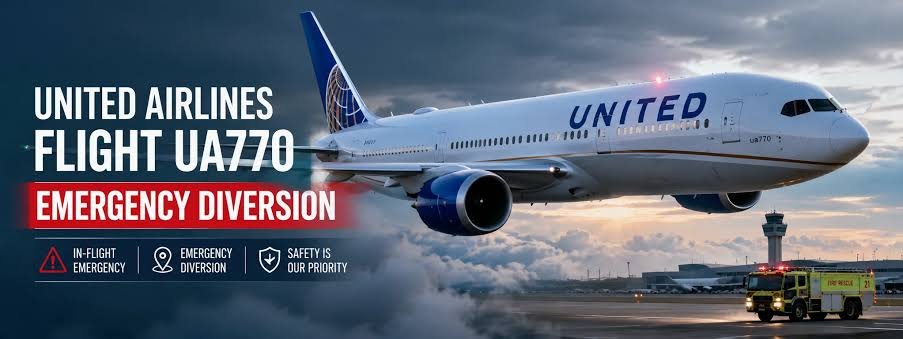
United Flight UA109 Diversion: The Quick Summary
On October 30, 2025, United Airlines Flight UA109 diverted to Dublin, Ireland, roughly three hours into its journey from Munich to Washington Dulles. The cause wasn’t a mechanical failure, a security threat, or a passenger emergency. It was a medical issue involving a cabin crew member.
The aircraft landed safely, the situation was handled on the ground, and the flight continued to Washington the same day. If that sounds almost anticlimactic — good. That’s actually the point.
What Route Does UA109 Normally Fly?
United Flight UA109 is a scheduled long-haul route connecting Munich Airport (MUC) in Germany with Washington Dulles International Airport (IAD) in the United States. It’s typically operated with a Boeing 787-8 Dreamliner, a widebody aircraft built specifically for long-range transatlantic crossings.
On the day in question, the flight was operated by the Dreamliner registered N28912, departing Munich at around 12:14 PM CET.
What Caused the UA109 Diversion?
Here’s where a lot of online speculation went sideways in the hours after it happened. Some early social posts guessed mechanical trouble. Others guessed weather. Neither was right.
According to aviation tracking reports, a flight attendant developed a worsening medical issue mid-flight — specifically pain from a blister — that made it difficult to continue performing required safety duties for the remainder of the roughly nine-hour crossing.
Aviation regulations require a minimum number of medically fit crew members on board at all times. Once that threshold couldn’t be guaranteed, continuing to Washington simply wasn’t an option under the rules. Diverting wasn’t a judgment call about comfort — it was a compliance requirement.
I know that sounds almost mundane compared to the dramatic headlines some sites ran with. But that’s honestly how most diversions actually work.
Why Did the Flight Divert to Dublin Specifically?
This wasn’t an improvised decision. Transatlantic flights operate under ETOPS rules — Extended Twin-Engine Operational Performance Standards — which require the aircraft to always remain within reach of a suitable alternate airport throughout an ocean crossing.
Dublin is a well-established diversion point for exactly this reason. It offers:
- A location well-positioned along common North Atlantic routes
- Runway length suitable for widebody aircraft
- Established medical and emergency response capability
- Frequent familiarity from airlines operating transatlantic routes
The diversion occurred roughly 90 minutes after the decision was made, with the aircraft turning back westward over the Atlantic — around 500 to 600 nautical miles west of Ireland — before landing in Dublin.
Timeline of the Diversion
Based on tracking data and contemporaneous reporting, here’s roughly how the day unfolded:
- ~12:14 PM CET — UA109 departs Munich as scheduled
- ~3 hours into flight — Crew member’s condition worsens; captain decides to divert
- ~3:00 PM GMT — Aircraft lands safely at Dublin Airport
- Following landing — Medical assessment and required operational checks take place
- ~4:15–4:20 PM GMT — Flight departs Dublin, resuming course to Washington
- Same evening — UA109 arrives at Washington Dulles, roughly two hours behind schedule
Notably, another flight — Delta DL257, en route to Boston — diverted to Dublin around the same time window, unrelated to UA109’s situation. Worth mentioning only because some early confusion online conflated the two events.
Were Passengers in Danger?
No. This is probably the most important thing to clear up. The aircraft itself was never compromised. There was no mechanical fault, no fire risk, no structural concern.
Most passengers stayed onboard during the ground stop while medical staff assessed the crew member and operational teams completed the required checks. The delay ran approximately two hours total — an inconvenience, certainly, but a routine and well-managed one by aviation standards.
Is This Kind of Diversion Common?
More than most travelers probably realize. Medical situations, whether involving passengers or crew, account for a meaningful share of flight diversions on long-haul international routes. Weather-related diversions tend to happen more often on shorter domestic routes, while mechanical diversions are less frequent but tend to draw disproportionate media attention.
In my view, that’s part of why UA109 became such a talked-about search topic — flight tracking tools let anyone watch a widebody jet make a dramatic mid-Atlantic U-turn in real time, even when the underlying cause turns out to be fairly ordinary.
What This Diversion Says About Aviation Safety
There’s something almost reassuring about how unremarkable the resolution was. A regulation existed. A situation triggered it. The crew followed procedure. Passengers reached their destination the same day.
That’s not a thrilling story, and I think that’s exactly the point. Boring outcomes are what good safety systems are designed to produce.
Frequently Asked Questions
What caused the United Flight UA109 diversion? A cabin crew member developed a worsening medical issue mid-flight, which meant the aircraft could no longer meet minimum crew fitness requirements to continue safely.
Was there a mechanical problem with the aircraft? No. The Boeing 787-8 operating UA109 remained fully operational throughout the diversion.
How long was the delay? Passengers experienced a delay of roughly two hours before continuing on to Washington Dulles the same day.
Why was Dublin chosen as the diversion airport? Dublin is a pre-planned ETOPS alternate on this route, offering suitable runway length, medical facilities, and emergency response capability for transatlantic diversions.
Final Thoughts
The United Flight UA109 diversion ended up being exactly what it looked like from the outside once the facts settled: a precautionary, procedure-following response to a crew health issue, resolved within hours with no lasting disruption. Dramatic on a flight tracker, routine in an operations center.











Leave a Reply